georgia gerber
6790 heggenes rd
clinton, wa 98236
(360)341-6382
email
us
|
|
|
|
|
Overview
of the Bronze Casting Process
(Downloadable
PDF Page 1 Page
2)
Nearly all of Georgia Gerber's work
is produced at her own foundry,
utilizing the lost wax casting method. She learned the
foundry process
during her college years at both the Bucknell University
and
University of Washington Art Foundries.
Almost always the creation of bronze sculpture in multiples
(editions) and producing one-of-a-kind pieces are
accomplished in the same manner; the artist sculpts the form and a
rubber
mold is made from the sculpture.
A wax replica is then cast from this mold, and this
replica is in turn cast in bronze using the lost wax process, described
below. For each sculpture in an edition, a new wax is cast
from the rubber mold.
During her years in the Bucknell University Foundry Georgia
and her professor, William Lazansky, developed an alternative
approach to one-of-a-kind castings that precluded the need
for making an expensive, labor-intensive rubber mold. Georgia
and her crew have made further improvements to this system,
adapting it especially to facilitate the casting of large-scale
work. All of Georgia's unique public installations have
been cast using this system. We know of no other foundries
that use this approach.
The outline below illustrates this system. Note that many
steps are the same as for the casting of multiple copies
of a sculpture. For such edition pieces, each individual
wax replica is sprayed with investment (similar to Step
3), and then treated essentially the same as unique pieces,
beginning with Step 6.
 |
From Clay to Bronze |
Casting One-of-a-kind Bronze Sculpture in the Studio and
Foundry of Georgia Gerber
Step
1
Georgia Sculpts in water-based clay |
Step
2
The finished sculpture is sectioned into castable-sized
pieces with thin metal shims.
Step 3
An "investment" made of sand, plaster,
and vermiculite is applied to each section to
a thickness of about 5 inches. |
|
Step
4
Each section is removed and cleaned. There is
now a negative imprint of each section of the
sculpture captured in plaster. |
Step
5
A ¼" thickness of wax is pressed against
the negative imprint. |
|
|
Step
6
A "plumbing" network of wax (sprues and
gates) is connected to the wax.
|
Step
7
The entire section piece, with the pressed wax and sprue
system attached, is encased in a larger cylinder of
investment material - with part of the plumbing system
protruding out of the top. |
Step
8
The cylinder is placed upside down in a large kiln and
heated with propane to 1,000°F for about 48 hours,
which evacuates the wax (hence, the "lost wax"
method"). This leaves a void inside the cylinder
wherever there was wax. The negative plaster imprint
imbedded inside the cylinder now has a ¼"
void adjacent to its surface, connected to the voids
left by the melted plumbing network. Since this network
originally protruded out the top of the cylinder there
is now a hole that provides access to all the voided
spaces inside the cylinder.
|
Step
9
The cylinders are placed right side up in a pit and
surrounded by sand to re-enforce the molds as the metal
is poured in.
Step 10
Bronze ingots are melted in a furnace to about 2,000°F
and poured into the hole in the top of the cylinder.
The molten metal flows through the plumbing system and
fills the ¼" space against the negative
plaster imprint, taking on the positive form. As it
cools, the metal maintains this positive form, and so
replicates that section of the original sculpture.
|
Step
11
After cooling, the cylinders are broken open and the
raw castings cleaned. The plumbing system - now also
replicated in bronze - is cut off to be recycled in
the next melt.
|
Step
12
The individual cast sections are welded together, like
pieces of a puzzle, to form the bronze replica of the
original clay.
|
Step
13
All welding lines and other flaws are tooled by skilled
artisans to make a seamless bronze sculpture.
|
Step
14
The final step is the application of patina chemicals
- usually to a heated bronze - to get the coloration
desired. Finally, a number of coats of wax are applied
to seal and protect the finish. |
|
 |
foundry crew |
In the foundry there is a wide range of skills that
are needed, from mold making to final finish. The
Gerber Foundry has been fortunate to have a small,
dedicated, and skilled staff of artisans who play
an essential role in producing high quality bronzes.
In a small working foundry it has been
important that each artisan become a
sort of jack-of-all-trades, though each
also has developed particular areas
of expertise. No skill is more important,
however, than the ability to do the
final tooling. This is the phase in
which all the welding lines and casting
flaws are basically re-sculpted in bronze
to match the original sculpture. This
often means re-creating texture and
form that has been lost due to the assembly
process. On a large piece, this can
be a significant task. This work requires
incredible attention to detail, great
skill with a range of tools, and above
all an artistic sensibility that can
recognize and replicate the artist's
original intent. Virginia is a master
at this crucial aspect of foundry work.

Virginia Keck has been working with
Georgia almost from the beginning of
the foundry in 1983. She displays her
own sculpture at the Artisan's Co-Op
Gallery in Langley, Washington. Besides
tooling, Virginia is on the metal pouring
crew and specializes in assembly of
the large-scale work. She is a dancing
enthusiast, and occasionally draws out
the pattern of steps for new dances
on the foundry floor.

Georgia's husband, Randy Hudson, runs
the business end of things, makes molds,
takes photos, pours waxes, does installations,
shipping, and anything else that can
get him out of the real work in the
foundry - though he does pour the bronze.
He claims that his two smartest moves
in life were marrying Georgia and never
learning how to weld. Randy is a concertina
player and singer, and a member of two
local music groups, "No Band Is
an Island" and "The Rural
Characters".
|
|
 |
sculpting |
Georgia
sculpts almost every day. She usually works in "Idaho
Buff" - a water-based clay commonly used for pottery.
She likes the softness and fluidity of this material,
which allow her to work quickly and expressively. It
is common that she has two sculptures underway at any
time - often a large commissioned piece and a smaller
edition piece. She does not like to focus on one sculpture
for too long at a sitting, and so moves back and forth
between sculptures for fresh perspectives.
Georgia seldom draws or makes models before beginning
a piece. Her ability to visualize in three dimensions
lets her start right in by piling blocks of clay into
the general form. Most sculptures, even the largest
ones, are solid clay with minimal armature support.
This gives Georgia flexibility in making changes as
she proceeds.
Most sculptures start out quickly as she blocks out
her vision in rough form. Even a large sculpture
may be proportional and recognizable in
only a couple of hours. However, from that
stage until completion may take two weeks
or two months, depending on how she feels
about the piece. On the subject of completion,
she is fond of saying "Much of art is knowing when
to stop".
|
|
 |
casting |
The pouring of molten bronze is the intense centerpiece
of the foundry experience. New metal ingots and recycled
sprues and gates from previous castings are heated in
a furnace by a mixture of propane and forced air to
around 2000°F. The metal is contained in a silicon-carbide
vessel known as a crucible, which can withstand the
intense heat. The crucible we use holds 275 pounds of
molten bronze. A typical pour day consists of melting
three pots in succession to fill all the molds. We pour
about every three to four weeks, depending on demand
and the state of other work going on in the foundry.
The
heat of the metal is measured with a pyrometer, an
electronic thermometer, submersed in the pot. When
the correct heat is reached the crucible is plucked
out of the furnace by a jib crane and hoist, which
bears all the weight and allows access to the molds.
A layer of debris, or slag, must be skimmed off the
top of the melt before pouring.
Casting is a two-person job, with one person doing
the actual pouring and the other stabilizing the holding
shank and controlling the hoist to raise and lower
the pot as needed. It is possible, though rare, to
pour the metal so accurately into the cup hole of
the mold that there is no spill over or splashing
whatsoever. The occasional perfect pour is a celebrated
event.
As the metal fills the mold it makes a sound that
rises in pitch as it nears the top. This is always
a welcome sign that indicates all has gone well. It
is especially welcome if the pourer has gone ahead
and started a mold with a questionable amount of metal
left in the pot. Generally such gambles are not taken,
but if a pour does come up short there is a good possibility
it can be completed from the next melt, and the seam
line that occurs can be repaired by welding.
|
|
 |
patina |
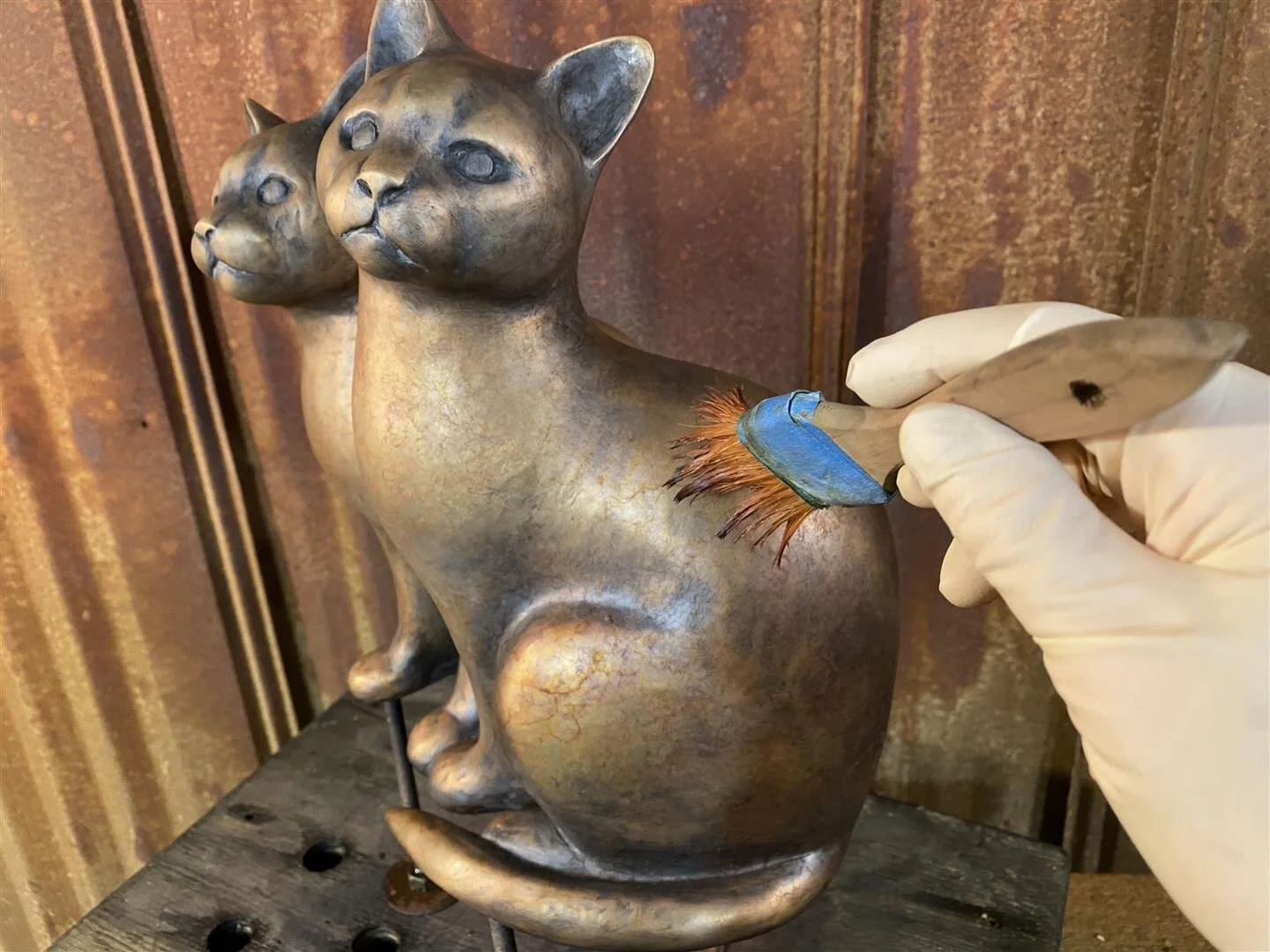
In
a strict sense the term "patina" refers to
the thin layer of corrosion, usually brown or green,
that appears on bronze as a result of natural or artificial
oxidation. In the more general use of the term it refers
to whatever finish a bronze sculpture ends up with.
It is thought by some that the art of patination developed
as an attempt to simulate the natural patinas found
on ancient bronzes that were found buried or in sunken
vessels. It may in fact have been that these bronzes
were originally painted or colored in other ways, but
the beauty of what nature had done to them encouraged
"patinuers" to find ways to artificially cause
such effects.
The most common way to patina a bronze is use a variety
of chemicals to encourage oxidations of various colors.
Generally, the brighter and more intense effects are
achieved by heating the bronze first, and applying
the chemicals by either brushing or spraying.
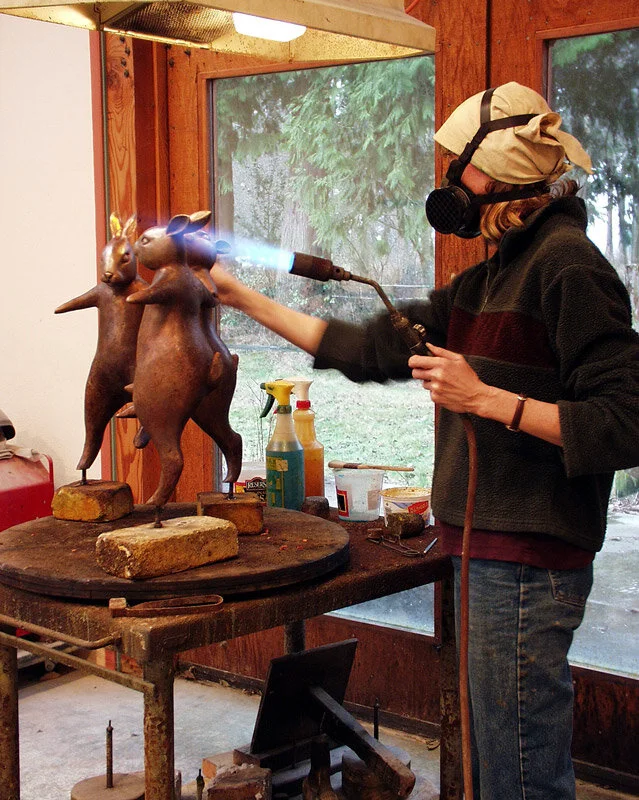
Georgia patinas most of her own sculptures. She uses
three basic chemicals, which when combined in various
strengths, application techniques, and differing heat
levels can produce an astounding array of effects.
Because any particular effect depends on many variables,
individual patinas can vary somewhat from piece to
piece even when attempting to replicate a particular
look. This is why she tells clients that "You
can order any patina you'd like, so long as you take
the one you get." This is mostly in jest, because
in reality it is usually possible to create a specific
look, though it certainly is true that every piece
will have its own unique charm.
The final step in finishing a bronze is the application
of wax to the hot metal. Waxing with the metal hot
and expanded makes for a durable finish that can be
buffed to a high sheen once the metal cools. Periodic
renewal of the wax will enhance the look of a sculpture
and protect the stability of the patina. See Maintenance
for more details.
|
|
 |
mold making |
 |
|
|